
REEL SEAFASTENING

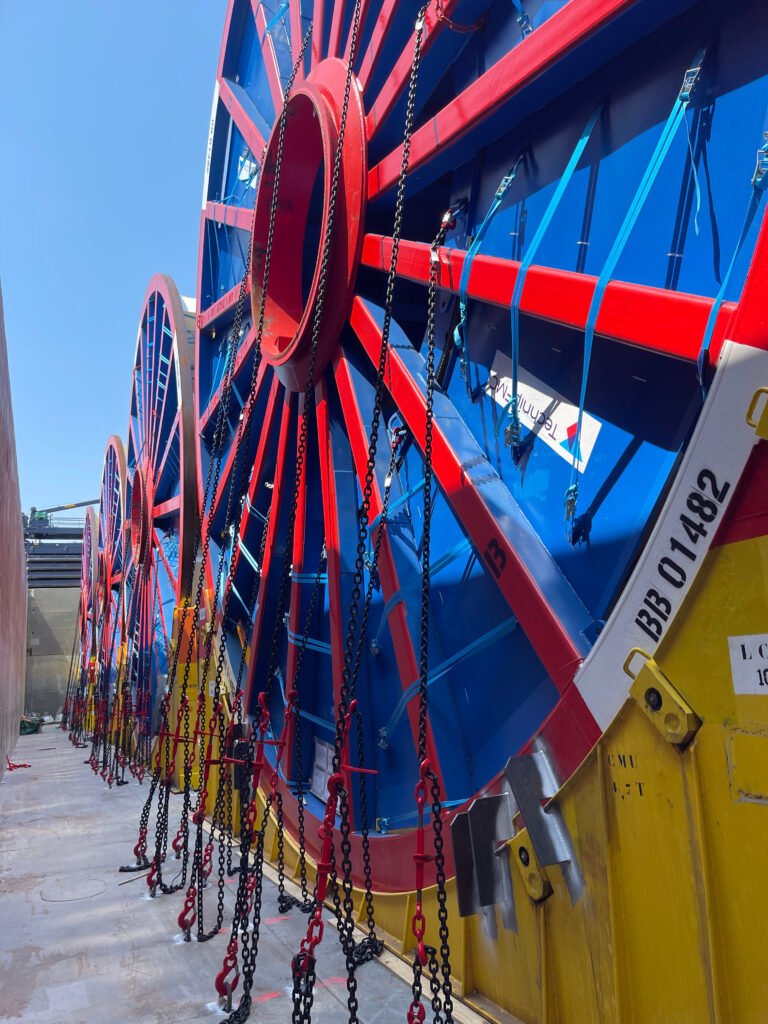
OPC provided seafastening engineering for the marine transport of flexible pipe and umbilical reels for the Captain & Gannet project. The scope covered two voyages carrying nine reels, with diameters up to 11.4m and individual cargo weights approaching 370tonnes.
The work combined transport acceleration calculations, cargo securing assessments and detailed arrangement drawings to define how each reel would be restrained aboard the vessel.
Transport Loads and Cargo Arrangement
Separate assessments were developed for each voyage, accounting for the vessel’s loading condition and the position of each reel within the cargo hold.
Longitudinal, transverse and vertical accelerations were derived using DNV ship rule formulations and the marine transport provisions of DNV-ST-N001. The calculations incorporated the voyage duration and the weather restricted design basis.
Each reel was assessed using its weight, centre of gravity and cradle support dimensions. This established the forces and overturning moments that the securing arrangement needed to resist.
Seafastening Design
The reels’ elevated centres of gravity made transverse overturning an important consideration alongside sliding. The securing arrangements combined welded stoppers at the cradles with lashings positioned to provide the required restraint.
Lashing geometry was developed for each reel, with chain lengths and horizontal and vertical angles recorded on the drawings. These angles determined how much of each lashing’s capacity contributed to resisting movement and uplift.
Longitudinal and transverse stoppers were specified around the cradle bases. The drawings also defined dunnage, welding and inspection requirements, connecting the calculation work with the details needed for installation.


Engineering Deliverables
The project package included:
- Transport acceleration calculations for both voyages.
- Individual reel securing calculations covering sliding, uplift and overturning.
- Cargo stowage and seafastening arrangement drawings.
- Detailed lashing layouts and geometry schedules.
- Stopper design calculations and fabrication details.
- Installation notes covering dunnage, welding and inspection.
The resulting documentation defined the securing requirements for each cargo arrangement and provided a coordinated basis for fabrication, installation and technical review.